Breaking Down the Recruiting Brick Wall: Evaluating & Selecting Candidates

This article is the last in a three-part series looking at how your organization can improve its hiring processes. Just joining us? Read parts one and two to learn about creating your success profile and sourcing candidates for your positions.


In Post 2 in our series “Breaking Down the Recruiting Brick Wall: How to Build More Effective Hiring Practices,” we shared a few active ways to go beyond your standard job postings and effectively source and recruit the right candidates for your organization.


Now that you know how to identify the top candidates for your pipeline, how will you evaluate them properly in order to make the best hire possible?


To assess candidates, your organization may follow standard practices such as reviewing resumes to look for at least the minimum qualifications; bringing qualified candidates through an interview process; or conducting reference checks with candidates’ former employers.


Many organizations often believe using one or two of these practices will be enough to decide whether a candidate is the right fit. But, rather than relying on a face-to-face interview or a reference check, putting together all of these practices (and more) will better allow you to gain a truer picture of who a candidate really is and how they will fit in at your organization. 


Today we’ll help you take your core candidate evaluation practices to the next level and show you how to combine interviews, reference checks and other assessment tools to increase your chances of making a great hire.

Combining Assessment Tools to Evaluate & Select Candidates

Remember Your Candidate Success Profile

Before you begin evaluating candidates, refer back to the Candidate Success Profile we discussed in Post 1 to know what to look for when reviewing resumes, what to address with interview questions, etc. Like with the other steps in your hiring process, using the Success Profile as the foundation for your assessment process will ensure you choose the candidate with the right hard and soft skills needed in order to succeed in the role.


Nail the Interview

How would you rate your interview process? How would candidates rate it? A strong and consistent interview strategy is critical in evaluating candidates. Here are a few things to consider when putting yours together.


The Interview Team

Who from your organization will interview candidates? Should candidates meet with everyone in the first round, or will interviewers meet with candidates at different stages of the process? And will the interviews be cross-functional, or will candidates only meet with members of the hiring department? 


Decide on the size and scope of your interview team at the beginning of the process, and follow the same interview structure and schedule with each candidate you bring through the interviews.


Maintaining a consistent interview team makes it easier to ensure that everyone involved in this stage understands the needs of the role and the qualifications you are seeking in a candidate. Logistically, keeping your interview team consistent can also make scheduling interviews go more smoothly, which will help you move quickly with candidates and maintain search momentum.


The Interview Questions

Use your Success Profile to develop questions that address the key areas you’ve identified that a candidate will need to excel in this role. Consider assigning specific skillsets for individual interviewers to focus on based on their respective areas. For example, a member of your finance team could assess the candidate’s analytical competence while a human resources professional evaluates cultural fit. You should also make sure to keep questions open-ended.


Ultimately, you want to design questions that will prompt candidates to provide specific examples relating back to the Success Profile or allowing you to observe their skills in action. Below is an example of what we’re talking about.
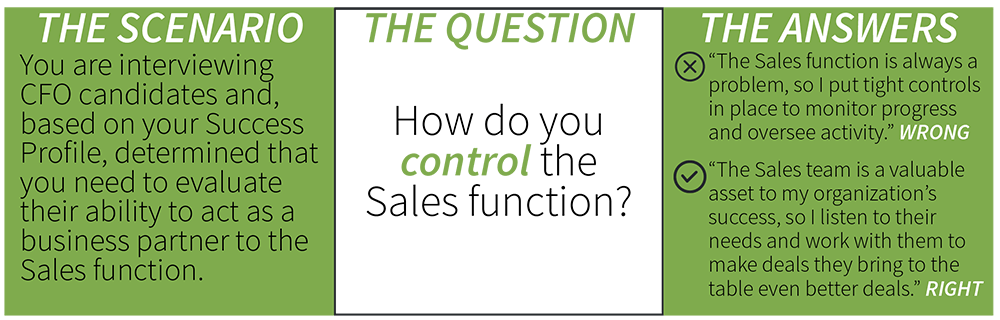
How you word your interview questions is crucial in eliciting an answer that gives you a better picture of the candidate’s views and working styles. In the scenario above, the word “control” baits the candidates, enabling you to figure out if and how they are able to partner across functions within your organization.


Scenario-Based Work Examples

Another way to evaluate candidates’ fit during the interview process is to assign a project to complete prior to your in-person meeting with them. These scenario-based work examples allow you to assess hard and soft skills that may be challenging to evaluate with questions alone.


For example, if filling a marketing position, you could ask candidates to develop a go-to-market strategy for a new product launch to present at their in-person interview. An assignment like this can allow you to see not only how candidates think strategically and creatively but also their ability to present to a leadership team.


Remember that these assignments or projects should also be based on the Success Profile; if “strong presentation skills” are not a key area you outlined, developing a way to evaluate this attribute would be irrelevant to your interview process.


2 More Tools to Help You Determine Who the Candidate Is


Psychometric Assessments

Many of our clients use assessments such as DiSCPersonalysisMBTI and StrengthsFinder as evaluation tools when selecting new team members.

These tools measure an array of individual attributes, including behavior & personality, skills & competencies, emotional intelligence, motivators and values. And they aren’t just used for recruiting and hiring; many assessment suites include tests that address individual development & team building, job analysis & benchmarking, performance management and more.


Psychometric assessments can be valuable to an organization’s development and people management strategies, but they are more effective when you invest in them across your organization; rather than using an assessment for a single hire, you should adopt it for all current and new employees in order to assess your organization as a whole and maintain consistency going forward.


You will also need a trained facilitator to administer the test and interpret the results. If you aren’t ready to commit internal resources yet, engage a consultant who specializes in one or more assessment tools to oversee this process.
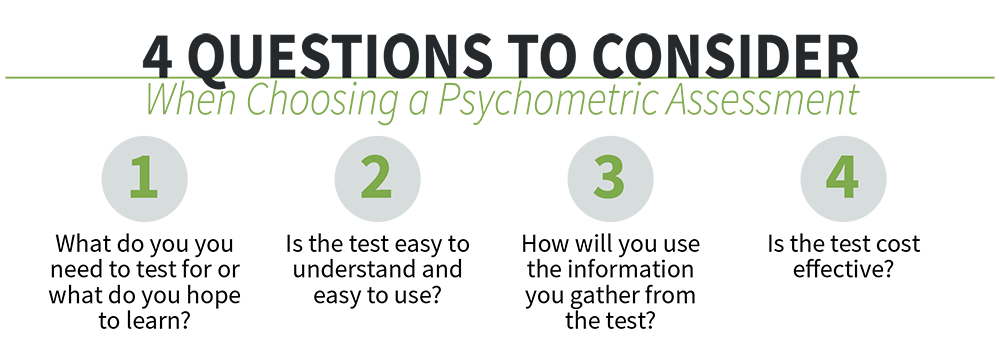
At 180one, we are big fans of incorporating these types of tests into your overall assessment approach, but remember that these tools are just one piece of your entire evaluation process and should not be considered “hire or not hire” tests.


Reference Checks

Most organizations conduct reference checks during the hiring process, but do you know how to make the references you receive more effective in assessing a candidate? Here are a couple of tips to help you improve your reference checks.


Ask the candidate for the right references.
The quality and reliability of your reference checks rely first on where the references come from. Again, refer back to your Success Profile as a reminder for exactly what you are looking for and determine who you need to talk to in order to learn more about how a candidate satisfies those key areas.


Hiring for a leadership position? Conduct a “360 Review” by having candidates provide you someone they report to, someone who reports to them and someone who is a peer to them to serve as references.


Rather than the candidate selecting the references to check, you could also specifically ask to speak to a former boss at ABC Company; how the candidate responds to this request will also be very telling in evaluating their fit for your organization.


Ask the references the right questions.
Like with interview questions you ask a candidate, questions for reference checks require finessing in order to draw out responses that will be useful in evaluating the candidate.


Need to know in what areas a candidate may be weak? Rather than asking, “What is the candidate’s biggest weakness?” ask a reference, “How can we help develop the candidate?” for a more honest and authentic response.


Putting All of the Pieces Together

After collecting information about your candidates through various channels (resumes, interviews, assessments, references, etc.), how do you use that data to help you make a hiring decision?


A pragmatic approach to evaluate candidates consists of developing a simple ranking system to see how their skills and fit stack up.


Create a Candidate Assessment Scoring Matrix and rank every candidate using a numeric scale on how well they meet the criteria laid out in your Success Profile.


Make sure you have the evidence to support your rankings, though. If you didn’t assess a candidate’s leadership qualities in the interview, psychometric assessment or reference check, for instance, do not assume that they are a leader just because they have that title at their current organization.


Here is an example of a simple Scoring Matrix to give you an idea.
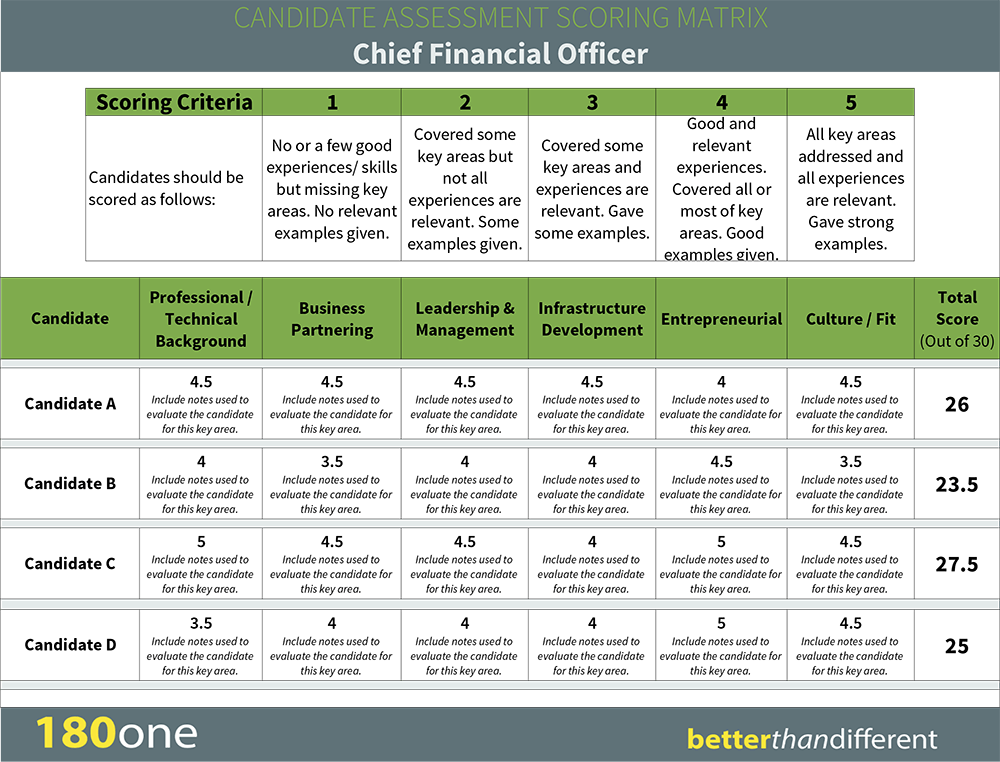
In the end, you want to feel confident in your hiring decision, and laying all of the information you gathered out in a Scoring Matrix will take the guesswork out of deciding whether a candidate is the best choice for the role and for your organization.


A Final Recap of the “Breaking Down the Recruiting Wall” Series

Much of the conversation about what makes a company successful today centers on one main thing: its people. But, while hiring and cultivating top talent is a priority for most organizations, many companies still lag behind when it comes to investing in sourcing, recruiting and assessing new candidates.


Over the past few months, 180one has provided insight into the marketplace and tips and strategies for how to up-level your company’s hiring practices so you can start “walking the walk” and investing more in your people.


After reading the “Breaking Down the Recruiting Brick Wall” series, you are now equipped to:

  • Build a strong foundation for your recruiting and hiring processes by knowing what you’re looking for when it comes to the ideal candidate for a position and your organization
  • Take a more active and creative approach to sourcing new talent by posting jobs more strategically, leveraging the media to promote your open positions, targeting specific candidates & companies and more
  • Redevelop your assessment process to more accurately evaluate and select the right candidates for your organization


Of course, elevating your entire hiring process may sound like a daunting task, but this is why the retained recruiting industry exists. For organizations that aren’t ready to overhaul their systems or don’t have all of the pieces in place yet internally, a retained search firm like 180one can provide the resources, experience and know-how to find the candidates who will succeed in the most challenging roles.


Ultimately, your people are your best asset, so there is no reason why you shouldn’t start investing in finding the right professionals for your organization today.
By Effie Zimmerman December 11, 2025
Vice President of Operations ABOUT THE COMPANY Founded in 1993 in Portland, Oregon, Pavement Maintenance Inc. (PMI) specializes in sealcoating, striping, pavement and concrete repair, and parking lot sweeping for leading property managers and facility owners throughout the region with its dedicated team of 100 employees. The company serves a diverse customer base across commercial, industrial, multifamily, retail, and healthcare properties, focused on recurring maintenance work and long-term customer relationships. With PMI’s acquisition of Vancouver Paving, its service offering expanded into all phases of paving, from minor repairs to new construction. In 2025, PMI joined Trinity Hunt Partners’ newly created paving services platform company Sage Surface Partners (“Sage”). Sage will be represented in the market with other best-in-class commercial paving services companies that share a strong commitment to quality, service, and their people. THE ROLE Reporting directly to the President of PMI, the Vice President (VP) of Operations will be a key member of the executive team, responsible for transforming and scaling the operational foundation of a small but growing pavement maintenance and repair company. This leader will combine strategic thinking with a hands-on, roll-up-your-sleeves approach to build systems, processes, and teams capable of supporting organizational growth. The VP of Operations will oversee field operations, project management, quality, safety, fleet/equipment, scheduling/dispatch, and customer satisfaction, driving operational discipline while preserving the agile, service-driven culture that has led to their market-leading position. RESPONSIBILITIES Operational Leadership & Scaling Build and mature operational infrastructure, including SOPs, workflows, and performance metrics, to support PMI growth targets. Provide day-to-day leadership of field and operations teams, ensuring high-quality and efficient delivery of our suite of pavement maintenance and paving services. Develop and implement initiatives such as business process modernization, cost optimization, and expansion readiness. People Leadership & Culture Development Model strong leadership behaviors, including clear communication, follow-through, integrity, and a commitment to developing others. Mentor and coach field leadership teams, helping them grow in decision-making, planning, and leadership capability. Promote a culture of ownership and engagement by empowering team members, recognizing strong performance, and fostering constructive problem-solving. Lead through change, helping employees understand the ‘why’ behind new systems, expectations, and processes that will support company growth. Project & Production Management Oversee scheduling, dispatching, crew planning, and resource allocation to ensure projects are delivered on time, within budget, and to quality standards. Introduce or refine project management tools and job costing practices to improve visibility and accuracy of operational performance. Identify bottlenecks and implement solutions that drive productivity and increase capacity. Safety, Compliance & Risk Management Strengthen the company’s safety culture through training, compliance monitoring, and the consistent application of best practices. Ensure adherence to OSHA, DOT, and other regulatory requirements across field operations. Establish scalable safety programs that can support future growth into additional markets. Fleet, Equipment & Materials Oversight Oversee procurement, maintenance, utilization, and lifecycle management of heavy equipment and materials. Streamline maintenance processes, ensure proper tracking systems are in place, and reduce downtime. Evaluate opportunities for capital investment to support efficiency and capacity improvements. Quality Assurance & Customer Experience Foster a customer-first mindset, ensuring work quality, communication, and responsiveness meet or exceed expectations. Handle escalated issues professionally, preserving customer relationships during a period of company transition and growth. Collaborate closely with sales and estimating teams to align operational delivery with customer commitments. Financial Stewardship & Strategic Execution Develop and manage operational budgets, forecasting production needs, staffing levels, equipment costs, and overtime management. Partner with the President and organizational leaders on reporting, KPI tracking, and operational improvement priorities. Provide insights and recommendations to leadership on growth opportunities, market expansion, and operational investments. QUALIFICATIONS Bachelor’s degree in Construction Management, Engineering, Business Administration, or related field preferred; equivalent experience considered. 7–10+ years of progressive leadership experience in construction or related service industries, or pavement maintenance operations. Experience working in a small-business environment, preferably during a phase of ownership transition or private-equity involvement. Strong background in building processes, implementing systems, and driving organizational maturity. Excellent leadership and communication skills, with the ability to motivate teams through change and rapid growth. Demonstrated expertise in scheduling, job costing, production management, and safety. Ability to be both strategic and hands-on—comfortable working in the field, in the office, and with investors. Interested in Learning More? 180one has been retained by PMI to manage this search. If interested in learning more about the opportunity, please contact Nicole Brady at 180one at 503.699.0184 / nicole@180one.com .
OBRC
By Effie Zimmerman November 11, 2025
Chief Financial Officer ABOUT THE COMPANY Oregon Beverage Recycling Cooperative (OBRC) is the industry steward of Oregon’s nationally recognized beverage container redemption program. We help keep Oregon beautiful by providing outstanding services to our partner distributors, retailers and to the public for the recovery, reuse, and recycling of beverage containers. OBRC serves as a not-for-profit statewide operator with full vertical integration, making the co-op a major employer and providing more than 500 clean economy jobs in Oregon. Through our statewide fleet operations, OBRC collects more than 2 billion containers annually for recycling across a network of 2,000+ retail stores, 27 redemption centers, 90+ bag drop locations, and transports them for counting, sorting, and processing across 6 statewide processing centers, preparing these containers for Grade-A domestic recycling. At a dime per container, the value of refunds adds up fast. This requires speed and accurate reimbursements for retailers and payments directly to consumers and nonprofits. OBRC manages the flow of deposits and container refunds, paying out over $200 million annually to Oregon consumers. No similar system in America has consumers and the beverage industry is working so closely together to achieve outstanding results, and Oregon’s Bottle Bill is popular with consumers. OBRC is proud to serve as the industry steward of Oregon’s Bottle Bill, ensuring Oregon’s beverage container redemption program continues to produce positive results for Oregonians and inspiring positive change beyond our borders as a model program across the globe. THE ROLE As a strategic business partner to the CEO, this financial leader collaborates with the executive team to provide finance and accounting support for companywide operational departments and other partnerships. Drive business performance by influencing and executing strategies that further OBRC’s mission statement. RESPONSIBILITIES Advise in an active and supportive manner to the CEO, Board of Directors, and other executive team members on strategic plans with a focus on controlling costs and meeting budget goals. Lead the Finance and Accounting team to provide and interpret financial information to improve performance, efficiency, and decision-making across all departments. Influence executive decisions with data and respectful challenges to the status quo. Ensure sound financial management and control practices, including internal financial reporting, internal controls, audit and tax compliance, accounting, strategic and operational financial planning and analysis, budget preparation and reporting, management reporting, as well as insurance and risk management. Direct and manage the treasury function, including planning and forecasting cash flows and maintaining the primary relationship with banking partners. Partner with Human Resources in overseeing and managing employee retirement benefit plans and other benefit plans, including health insurance, life, and disability insurance. Manage OBRC patron relationships and lead the team members in monitoring and signing up new cooperative patrons. Successfully monitor the monthly reporting process by patrons to ensure compliance with service agreements. Consult and lead business departments during the annual budgeting process and any required forecasting to support capital and business development projects. Provide timely and accurate analyses of budgets, financial reports and financial trends. Ensure data systems can meet the company’s business objectives. Compare actual performance against forecast and recommend corrective action when actual performance is significantly unexpected. Provide monthly internal reports and periodic reforecasting of the current year’s financial and business plans. Oversee OBRC’s Loss Prevention Department, which emphasizes asset protection on a companywide basis and security at specified BottleDrop locations. Review legal documents and manage legal challenges in collaboration with the CEO/COO and legal counsel. Supervise and manage a team of employees, including recruitment and hiring of staff, performance management, discipline, and terminations. Other duties as determined by business needs. EDUCATION & EXPERIENCE A bachelor’s degree in finance, business, or other related fields is required. An MBA or an advanced degree is preferred. 15+ years of progressively responsible financial leadership experience required, with a preference for prior public accounting experience. At least 3 of those years should have been in a CFO or financial executive leadership role. CPA is preferred. REQUIREMENTS – KNOWLEDGE, SKILLS, AND ABILITIES Strong verbal and written communication skills; ability to break down complex analysis and communicate effectively to all levels of both internal and external partners. Demonstrated leadership ability, confidence, executive presence, and ability to motivate accounting and other employees. Self-starter who works with a sense of urgency. Strong organization skills with exceptional attention to detail, with a high level of accuracy. Proficiency and professional knowledge of MS Word, MS Excel, and Outlook. Adaptability, and the ability to approach changes and problems with curiosity, humor with the ability to change course. Technical financial knowledge, including cash-flow management, reporting, and analysis. Strong interpersonal skills to listen to understand different perspectives and motivations. Ability to assess a business problem quickly and identify solutions that address the root cause. Ability to delegate tasks and support the team by being hands-on during periods of high need. Ability to effectively manage people and performance to deliver improved team performance. Experience with coaching and mentoring direct reports and assisting with conflict resolution. Interested in Learning More? 180one has been retained by OBRC to manage this search. If interested in learning more about the opportunity, please contact Tom Haley / 503-334-1350 /  tom@180one.com  .
By Effie Zimmerman November 7, 2025
Senior Director of Investor Relations ABOUT THE COMPANY As a leader in the global active lifestyle apparel, footwear, accessories and equipment industry, Columbia Sportswear Company has assembled a portfolio of brands dedicated to connecting active people with their passions. In addition to the Columbia brand, Columbia Sportswear Company also owns the Mountain Hardwear, SOREL and prAna brands. Founded in 1938 as a small hat company in Portland, Oregon, Columbia Sportswear Company today has grown into an industry icon with $3 billion in annual sales. As a global company, its brands are now sold in approximately 90 countries. Based in Portland, Oregon, the company is dedicated to making no-nonsense apparel, footwear and accessories to keep consumers warm, dry, cool, and protected, no matter what. Defined by its innovative gear, Pacific Northwest heritage, irreverent spirit and family business ethos, Columbia’s products continue to gain worldwide recognition, enabling them to unlock the outdoors for everyone. THE ROLE The Senior Director - Investor Relations (“the Director”) is part of Columbia Sportswear Company’s (CSC) global finance organization and supports CSC’s senior leadership team optimally positioning the Company to create shareholder value. The primary goal of the Director is to educate and update current and prospective shareholders and investment analysts about our business strategies, trends, risks, financial results, financial outlook, and other relevant matters. Building and maintaining constructive relationships between CSC and the investment community is essential to success in this position. The Director works to successfully lead CSC’s investor relations and financial communications program supporting quarterly earnings releases and other shareholder and investor events including CSC’s annual shareholder meeting, non-deal roadshows, one-on-one meetings, investor conferences and other similar events. Additionally, the Director is responsible for analyzing and interpreting financial, operational, and other related performance metrics for the Company, its competitors, and other market players to prepare financial and other material press releases, presentations, talking points, Q&A documents and other key messages. This position is also responsible for the Company’s competitive intelligence program. This includes researching and analyzing business and financial shifts and trends impacting our customers, competitors, suppliers and other stakeholders in our industry and then communicating these insights to senior leaders and commercial business units. RESPONSIBILITIES Leads in the planning, preparation, drafting and distribution of investor relations related documents, including quarterly earnings releases, earnings release script, CFO commentary, Q&A documents, key messages and talking points. Builds and maintains relationships with sell side analyst community, and assists with communications between the Company and the investment community. Conducts investor targeting for investor conferences, non-deal roadshows, and other investor meetings. Maintains and updates investor relations calendar, including scheduling investor/analyst calls, earnings conference calls, investor conferences, non-deal roadshows and onsite meetings. Develops a thorough understanding of the Company by regularly engaging with business and financial leaders to understand the Company’s business strategies, initiatives, risks, regulatory environment, financial plans and other significant matters relevant to investors. Creates and updates investor relations presentations for use in communicating with the investment community as well as similar financial presentation materials for internal use to the Company’s worldwide employee base. Manages Investor Relations portion of the Company’s website, including the creating and updating of content. Support finance and legal with reporting obligations including quarterly and annual SEC filings, and other reporting commitments. Manage creation of the Annual Report to Shareholders and partner with legal on the creation of the Proxy Statement and execution of the Annual Shareholder meeting. Monitors competitor and market information obtained from analyst reports and media sources; compiles relevant information into summaries for distribution to CSC’s senior leadership team and other relevant stakeholders. EDUCATION, EXPERIENCE & SKILLS REQUIRED Undergraduate degree in Finance, Business, Accounting, Communications or related field, MBA, or CPA a plus. At least ten years of broad business experience in multiple disciplines such as investor relations, investment banking or sell-side or buy-side research. Expert level of knowledge related to investor relations and SEC disclosure regulations, accounting practices, international business, and financial markets. High degree of financial literacy with attention to detail and accuracy. Excellent interpersonal, oral, and written communication skills, including presentation skills. High degree of organization and efficiency with demonstrated attention to detail. Demonstrated accountability and ability to meet deadlines. Ability to work both independently and collaboratively. Dynamic and disciplined thinker with intellectual horsepower. Highest ethical standards, integrity, authenticity, credibility, and character. Professional demeanor and ability to interact with persuasiveness and confidence. Impeccable judgement and maturity. JOB SCOPE Position is highly complex and frequently involves new and varied work situations. Performs duties under little supervision. Determines his/her own practices and procedures and contributes to the development of new ones (company-wide). Decisions are made within general company policy and legal guidelines. Mistakes/errors may result in the dissemination of incorrect information, which may impact investor relations. Ability to work under pressure and respond to intense questioning related to CSC’s financial position. Able to prioritize workload and manage multiple projects independently. Ability to problem solve, analyze/understand complex finance and accounting issues, and financial statement relationships. Able to read, retain and explain internal and external information on CSC’s business and the dynamics of markets and competitors. Communicate with investors and balance their need-to-know against company disclosure policies. Some travel is required. INTERPERSONAL CONTACTS Contacts are with others both inside and outside the organization, including significant engagement with the external investment community. Interactions usually involve information exchange of confidential and sensitive information. Interested in Learning More? 180one has been retained by Columbia Sportswear to manage this search. If interested in learning more about the opportunity, please contact Lisa Heffernan / 971.256.3076/ lisa@180one.com .
More Posts